
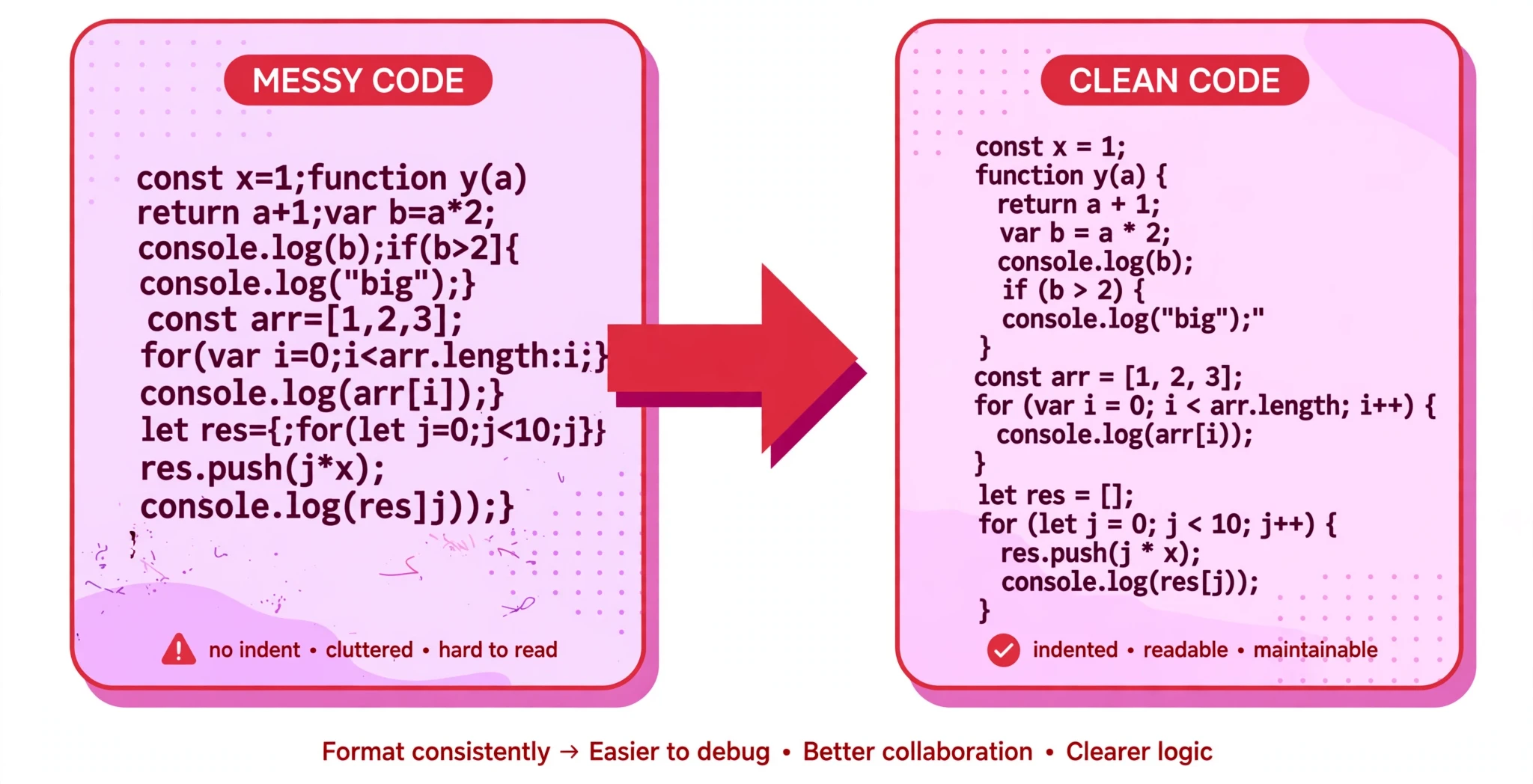
This formatter reads your code token by token — it is not a regex find-and-replace, and it never runs your code. Strings, comments, template literals, regular expressions and modern syntax (arrow functions, async/await, classes, destructuring, optional chaining) are preserved exactly. It only changes the layout, never the meaning: a line break after return, throw, break, continue or yield is kept, because joining it would change what the code does. Structural problems — unbalanced brackets, unterminated strings, template literals or comments — are reported below; this is not a full syntax check.
What is the JavaScript Formatter?
A JavaScript formatter takes code that has been compressed onto a few lines — or written with inconsistent spacing — and lays it out the way a person would write it: one statement per line, blocks indented, braces where you can see them. This free JavaScript Formatter does exactly that, and it does it safely: it reads your code token by token, the way a JavaScript engine reads it, instead of guessing with regular expressions.
That matters because JavaScript is full of traps for a careless formatter. A template literal with ${...} inside it, a regular expression that looks like a division, a string that contains a brace, an arrow function, async/await, a class, destructuring, or optional chaining — all of these have to survive formatting exactly as written. This tool understands each of them, so it preserves them. It also never runs your code. It only reads it and rearranges the whitespace, so formatting is completely safe even for code you do not fully trust.
It is made for students learning JavaScript, bloggers showing script examples, and developers who copied a minified script and need to read it. The result is the same code, only arranged so you can follow it: where each function starts and ends, what happens inside each block, and how the statements flow.
Everything runs in your browser. Your code is never uploaded, stored, or sent anywhere, so you can format scripts from a private or client project without a second thought.
How to use the JavaScript Formatter
There is no button to press — the tool formats as you type:
- Paste your JavaScript into the JavaScript input box. The tool loads with a sample script already in place, so you will see a formatted result immediately. Replace it with your own code whenever you are ready.
- Choose your Indentation. The dropdown offers 2 spaces, 4 spaces, or a Tab. The output updates the moment you change it, so you can compare the three at a glance.
- Read the result in the Formatted output box. The output appears on the right, and the stats line underneath summarises what happened.
- Copy or download the result. Use Copy to put the formatted code on your clipboard, or Download to save it as a file. Clear empties the input, and Reset restores the sample script.
If your code has a structural problem — unbalanced brackets, an unterminated string, template literal, or comment — the tool reports it underneath instead of guessing. It is not a full syntax checker, but it will tell you when something is clearly wrong. And it only changes the layout, never the meaning: a line break after return, throw, break, continue, or yield is kept, because joining it to the next line would change what the code does.
Worked example
Paste this compressed script into the input:
const greet=(name)=>{const message=`Hello, ${name}!`;console.log(message);return message;};
The JavaScript Formatter returns:
const greet = (name) => {
  const message = `Hello, ${name}!`;
  console.log(message);
  return message;
};
The arrow function, the template literal with its ${name} interpolation, and the return statement are all preserved exactly. Only the layout changed: one statement per line, the block indented, and the braces placed where you can see the function’s shape.
When a JavaScript formatter earns its keep
Reading a minified script. Scripts served to visitors are often compressed to save bandwidth, which makes them unreadable. When you need to understand one — to find why a feature misbehaves, or to learn how a technique works — pasting it through the formatter turns a wall of characters into statements you can read one by one.
Cleaning up code written in a hurry. A script that grew by pasting snippets from tutorials and forums usually has inconsistent spacing: some functions on one line, others spread out, indentation all over the place. Formatting it once gives the whole file a single, consistent shape, which makes the next edit much easier and makes mistakes easier to spot.
Preparing examples for teaching or writing. If you show JavaScript in a lesson, a tutorial, or a blog post, your readers need to read it as well as copy it. Formatted code teaches the structure of a function — its parameters, its statements, its return — instead of hiding it. Run your examples through the formatter before you publish them.
Tips for getting the best result
Pick the indentation your project uses and stick to it. Two spaces is the most common choice in modern JavaScript; four spaces is easier to scan in deeply nested code; tabs suit projects that already indent with tabs. The formatter lets you switch in one click, but your files stay easiest to read when they all use the same setting.
Read the warnings before you ignore them. An unbalanced bracket or an unterminated string usually means the code you pasted is incomplete — a closing brace left behind when you copied, for instance. The formatter reports these instead of guessing, so treat a warning as a hint to check your source.
Do not expect the formatter to fix logic. It arranges code; it does not debug it. A function can be beautifully formatted and still do the wrong thing. Formatting makes bugs easier to see, because the structure becomes clear — but finding them is still your job.
Keep a formatted copy for reading and a minified copy for serving. Browsers do not care about indentation, and visitors’ connections benefit from smaller files. Use the formatter while you work, then run the finished script through the JavaScript Minifier before it goes live — readable in your editor, small on the wire.
Use the sample to learn the settings. The example loaded in the tool is a small, complete script with an async arrow function, a template literal, a regular expression, and an array method. Change the indentation and watch the output change. It is the fastest way to see exactly what each setting does before you format your own code.
Frequently asked questions
Does the JavaScript Formatter change what my code does?
No. It only changes whitespace — line breaks and indentation. It deliberately keeps a line break after return, throw, break, continue, and yield, because joining those lines would change the meaning. Strings, comments, template literals, regular expressions, and modern syntax are preserved exactly.
Will it run my code?
No, never. The formatter only reads your code and rearranges its layout. It is safe to format scripts you have not reviewed yet, because nothing in them executes.
Will it fix broken JavaScript?
No. If your code has a structural problem, such as unbalanced brackets or an unterminated string, the tool reports it underneath instead of guessing. Fix the problem in your source and format again. It is not a full syntax checker, so it will not catch every kind of mistake.
Is my code uploaded anywhere?
No. Everything runs in your browser, on your own device. Nothing is uploaded, stored, or shared.
What happens to template literals and regular expressions?
They are preserved exactly. A template literal like `Hello, ${name}!` keeps its interpolation, and a regular expression like /d/ is recognised as a pattern, not mistaken for a division. That is why the tool reads your code token by token instead of using regular expressions to format it.
Conclusion
Compressed JavaScript is fine for a server and miserable for a person. The JavaScript Formatter turns it back into code you can read — one statement per line, blocks indented, indentation of your choice — without changing what any of it does, and without ever running your code or sending it anywhere.
Try it on the tool above, and when your script is finished and ready for visitors, shrink it back down with the JavaScript Minifier.